


Momentum is addictive in a remodel. The cabinets arrive, the room finally starts to look like a kitchen again, and everyone wants the next win: countertops. That’s usually when someone says the sentence that sounds harmless but can quietly wreck the finish: “We can install them now—then we’ll tighten and adjust the cabinets later.”
If you’re planning countertops in Shelbyville, KY, that shortcut is one of the biggest long-term risks you can take. Not because stone is fragile, and not because contractors are trying to scare you. It’s because a countertop—granite, quartz, quartzite, marble—behaves like a rigid, precision surface. It doesn’t “forgive” a moving base. It records it. And once it’s installed, every tiny cabinet issue that could’ve been corrected in minutes becomes something you’re forced to live around.
At Granite Empire of Louisville, we’ve seen this play out in real kitchens: a job that looked fine on install day, then weeks later a seam line starts to catch crumbs, caulk begins to split, a sink feels slightly loose, or a hairline crack appears near a cutout and nobody can agree why. Most of the time, the story started earlier—when countertops went in before the cabinets were truly finished.
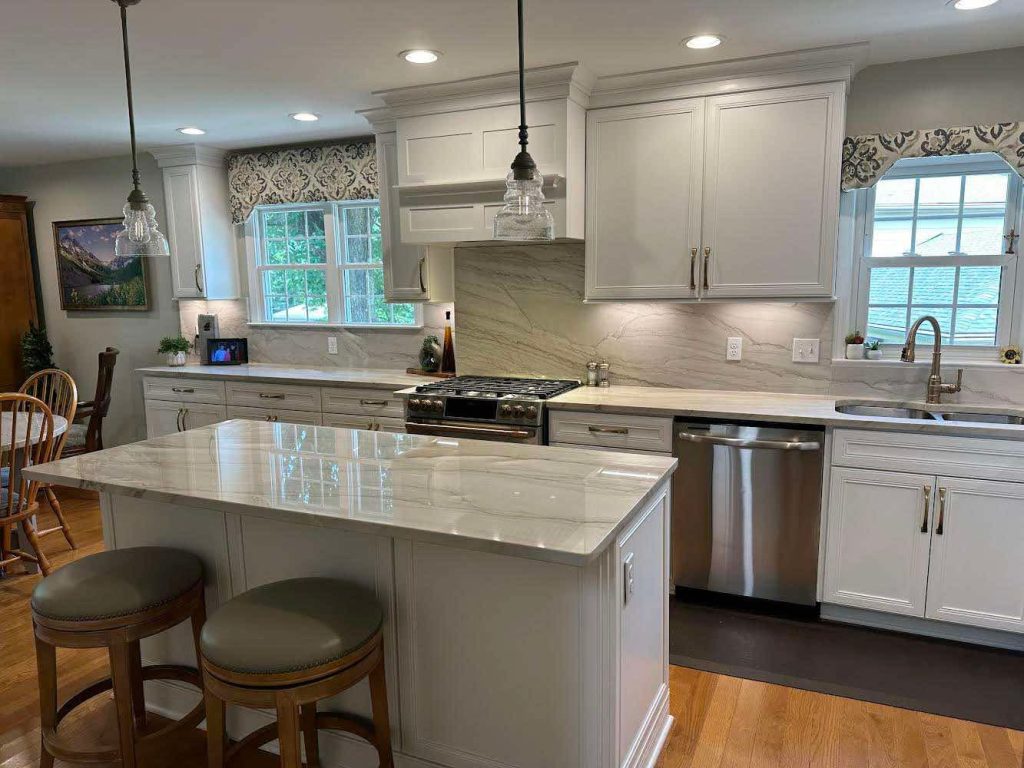
Why “Almost Installed” Cabinets Aren’t a Safe Base for Stone
Homeowners hear “cabinets are in” and assume the base is ready. In the countertop world, “ready” means something stricter. Cabinets need to be locked into their final position, fastened properly to studs, and connected together as one solid system. The top plane needs to be flat across the entire run—not just “level enough” at the ends. Islands need to be braced so they don’t rack or sway, even slightly, when you lean on them. Appliance openings need to be finalized so nothing shifts after the countertop becomes the “lid” that freezes the layout.
If that sounds picky, it’s because stone is picky. It’s not flexible like laminate. It’s not going to subtly bend to match a wall that bows or a cabinet run that dips. When installers set countertops in Shelbyville, KY, they’re placing a hard surface that relies on continuous support. If support is uneven, the countertop doesn’t adjust—the stress simply concentrates in the weakest areas.
And here’s the frustrating part: you often won’t see the stress immediately. The countertop can look perfectly fine for days. But tension doesn’t disappear because you can’t see it. It waits for real life to begin.
At Granite Empire of Louisville, we often explain it this way: installing stone on unfinished cabinetry is like placing a sheet of glass on a shaky table. It may sit there. But the moment the table shifts, the glass is the thing that suffers.
What You “Save” Today Becomes a Problem You Pay For Later
The first consequence of installing early is that you lock cabinet problems in place. Cabinets typically need small adjustments after the initial install—shimming, tightening, aligning, finalizing fillers and panels. Those adjustments are normal. But once stone goes on top, you dramatically reduce your ability to correct anything without affecting the countertop plane.
That’s where homeowners start noticing the “almost right” signs. The gap along the wall varies. The line behind the sink feels inconsistent. A caulk seam looks thicker on one side than the other. A backsplash doesn’t sit cleanly because the countertop edge isn’t perfectly consistent. If you’re paying for a kitchen to look finished, these details are exactly what keep it from feeling finished.
For people investing in countertops in Shelbyville, KY, this is the invisible cost of rushing: you trade a few days of schedule pressure for months (or years) of low-level visual annoyance.
The second consequence is structural stress—especially around weak zones like sink cutouts, cooktop cutouts, corners, and seams. If the cabinets underneath aren’t flat and stable, the countertop ends up spanning tiny gaps. It doesn’t look like a gap, but the stone is effectively bridging space. Every time someone leans on the counter, sets down a heavy appliance, or fills the sink, the load travels differently across the surface than it should. Over time, those loads find the vulnerable points.
That’s why cracks that appear “randomly” weeks later are often not random at all. They’re delayed consequences of a countertop installed on a base that was still changing.
At Granite Empire of Louisville, we’ve had homeowners call us in a panic after a late crack appears. The most common pattern is the same: the countertop looked perfect at first. Then the cabinets settled, got adjusted, or simply moved under daily use. Stone does not like movement.
Seams, Caulk, and the Truth They Reveal
Even when a crack never happens, early installation often shows itself in the finish lines—especially seams and caulk.
A professional seam can be clean, tight, and visually quiet. But seams are sensitive to movement. If the cabinetry underneath shifts after installation, a seam may become more noticeable. It can trap crumbs. It can develop a slight texture change. It can look “shadowed” under certain lighting, even if it was originally excellent.
Caulk is even more honest. Caulk is meant to be a flexible, thin seal—not a cosmetic band that hides structural misalignment. When cabinets aren’t finalized, the countertop-to-wall gap can change. Contractors compensate with thicker caulk lines. Thick caulk discolors faster, collects grime, and tends to crack or separate as things move.
If you’ve ever seen a kitchen where the caulk line draws your eye, there’s a good chance the sequencing was off. The caulk became a disguise.
When homeowners compare countertops in Shelbyville, KY options, they rarely think about caulk. But once you live with it, you can’t unsee it. Granite Empire of Louisville treats those finish details as part of craftsmanship, not an afterthought, because they’re the difference between “new countertop” and “new kitchen.”
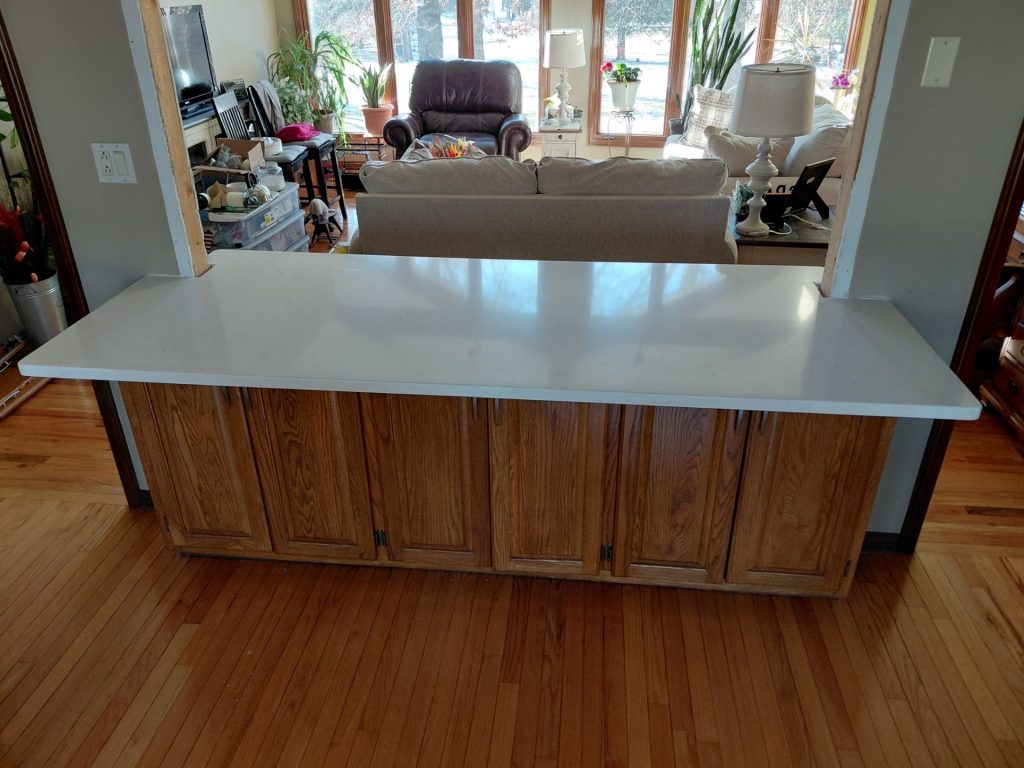
The Sink Base Problem Most Homeowners Don’t Expect
If there’s one area you should never gamble on, it’s the sink base. The sink zone carries weight and stress daily. Undermount sinks, especially, rely on stable cabinetry and proper support. If the sink base cabinet isn’t fully secured, the slightest movement can transfer stress into the countertop rails around the cutout. That’s how you get chips near the sink edge, cracks near cutout corners, or a sink that feels subtly unstable months later.
And it doesn’t take a dramatic failure. It can be small: a cabinet shifting a fraction, an installer tightening something later, a heavy sink load pulling differently than expected. Stone prefers a stable, finished foundation.
This is why homeowners planning countertops in Shelbyville, KY should treat the sink zone like a high-stakes area. The countertop isn’t just sitting there—it’s supporting a working station that gets used dozens of times a day.
At Granite Empire of Louisville, we focus heavily on sink base readiness because that’s where rushed installs most commonly turn into expensive fixes.
Appliance Fit: How a Countertop Can Make a Dishwasher Suddenly “Not Fit”
One of the most annoying consequences of installing countertops before cabinetry is finished is appliance fit—especially dishwashers and slide-in ranges.
Cabinet runs can shift slightly during final securing and adjustment. Filler strips can be added. Panels can be tightened. If the countertop is already installed, those changes can alter openings in small but meaningful ways. A dishwasher that slid in easily can become tight or stuck. A range gap can look uneven. The kitchen becomes a puzzle of tiny corrections you can’t make cleanly because the countertop has locked the geometry.
Homeowners often don’t connect this back to countertop timing. They just know something feels off. But in many cases, it started with placing countertops in Shelbyville, KY before the cabinet line was truly final.
The Worst Part: When Something Goes Wrong, Everyone Blames Everyone
There’s also a practical, real-world problem with early installation: accountability becomes muddy.
If a seam shifts, the countertop team may say the cabinets moved. If a crack appears, the cabinet installer may say the stone was forced. If the sink loosens, the plumber may say the cabinet wasn’t braced correctly. The homeowner is stuck in the middle with a problem that has multiple contributors and no clean answer.
That’s why the smartest remodels are the ones that remove ambiguity. Finalize the cabinetry. Confirm stability. Then template and install the stone. It’s not just better craftsmanship—it’s better protection for you.
At Granite Empire of Louisville, we prefer a clean process because it prevents the “blame triangle” that turns a small issue into a long, stressful dispute.

What a Smart Timeline Looks Like When You Want a Truly Finished Kitchen
If you’re aiming for a kitchen that looks clean, tight, and professionally built, the order matters. Cabinets should be fully secured and finalized before templating. Templating should happen only after cabinets, panels, and appliance openings are set. Then fabrication and installation can be done without forcing the stone into imperfect geometry. Once the countertop is in, everything else—backsplash, trim details, finishing—can align to the true reference line.
That’s how you protect the finish. That’s how you avoid thick caulk lines. That’s how you get seams that stay quiet. And that’s how you reduce the risk of late cracks that appear after the excitement wears off.
If you’re shopping for countertops in Shelbyville, KY, the biggest “money-saving” move isn’t rushing. It’s installing once, correctly, on a stable base.
At Granite Empire of Louisville, we’ve learned that the best countertop installs feel almost uneventful. No forcing. No improvising. No “we’ll adjust it later.” Just a finished cabinet foundation and a stone surface that sits exactly as it was designed to sit. That’s what keeps the countertop looking right not only on day one, but on day three hundred—when the kitchen is being used the way it’s meant to be used.
And if you want the shortest version of the advice: before you install countertops in Shelbyville, KY, make sure your cabinets are done—not “basically done.” Because stone doesn’t care how close you were. It only cares what’s true underneath it.