

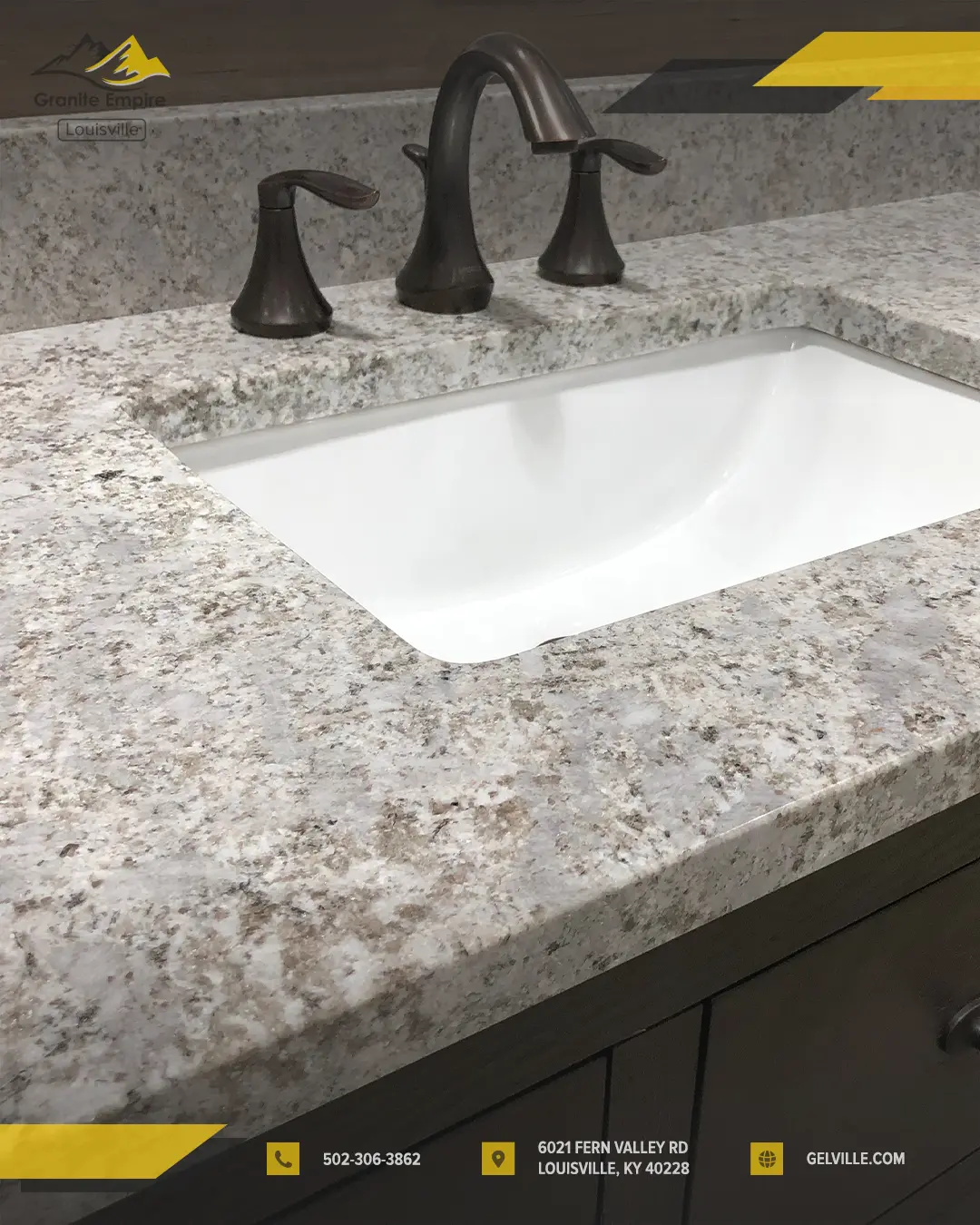
Yes, you can often replace a bathroom countertop without replacing the sink. The main requirements are that the existing sink is in good condition, compatible with the new countertop material, and suitable for safe removal and reinstallation. The answer also depends on whether you have a drop-in, undermount, vessel, or integrated sink.
For homeowners considering bathroom countertops in Lyndon, KY, keeping an existing sink can make a bathroom update more affordable and less disruptive. If the vanity cabinet and plumbing are still in good condition, replacing only the countertop may be enough to give the bathroom a noticeably different appearance.
At Granite Empire of Louisville, we help homeowners evaluate these details before fabrication begins. Our goal is to determine what can be reused, what needs to be replaced, and how the new countertop will work with the existing bathroom layout.
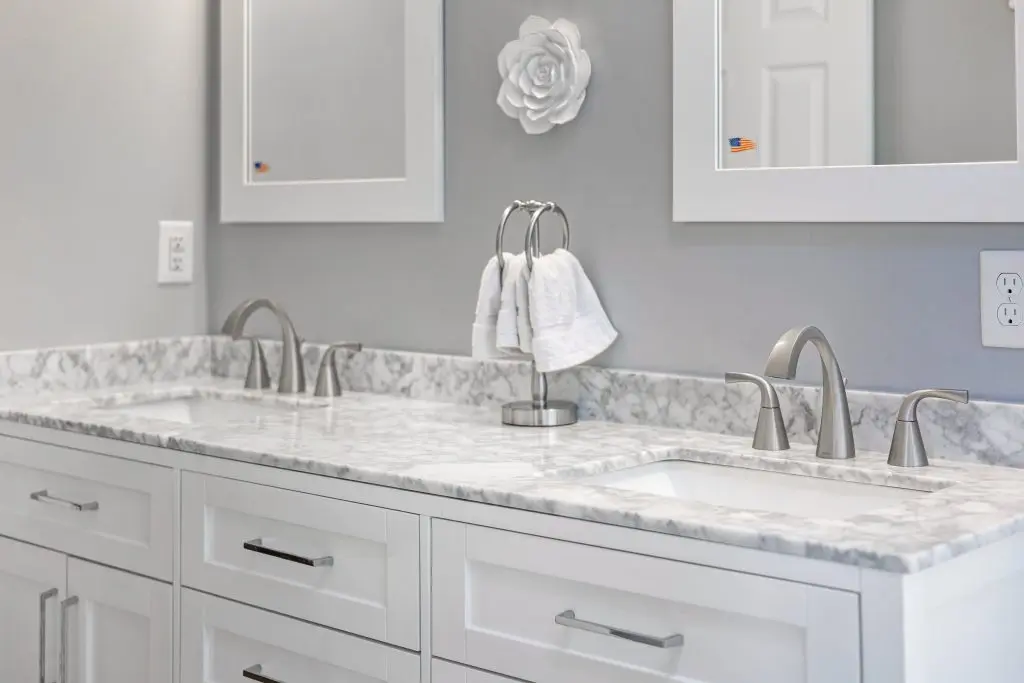
Can you reuse an existing sink with a new countertop?
Yes, many bathroom sinks can be reused when replacing the countertop, provided they can be removed without damage and installed correctly in the new surface.
A sink that looks perfectly fine from above may still have issues underneath. Before planning around it, we need to consider the mounting method, condition of the sink, plumbing connections, and whether the new countertop can accommodate the required opening.
The countertop material also matters. Granite, quartz, and marble can all accommodate different sink configurations, but cutouts and mounting arrangements must be planned before fabrication.
Which bathroom sink types can be reused?
Drop-in, undermount, and vessel sinks may be reusable, but each requires a different installation approach. Integrated sinks, which are manufactured as part of the countertop, generally cannot be separated and reused as independent fixtures.
| Sink Type | Can It Be Reused? | Main Consideration |
|---|---|---|
| Drop-in sink | Often | New cutout must match the sink |
| Undermount sink | Often, if removable intact | Mounting and support must be appropriate |
| Vessel sink | Often | Drain opening and faucet placement must align |
| Integrated sink | Generally no | Sink and countertop are one unit |
When homeowners contact us about bathroom countertops in Lyndon, KY, we ask what kind of sink they currently have. This helps us identify potential complications before materials are ordered.
Can I keep my existing drop-in sink?
Yes, a drop-in sink is often one of the easier types to reuse. Its rim rests on the countertop, covering the edge of the opening.
However, the new countertop still needs an accurately sized cutout. A sink opening that is too large may not provide adequate support, while one that is too small prevents the sink from fitting.
We recommend confirming the sink’s actual dimensions and installation specifications instead of relying only on its visible measurements.
Can I reuse an undermount bathroom sink?
Yes, but undermount sinks require more careful evaluation because they are attached beneath the countertop. Depending on the original installation, removing the sink may involve releasing adhesive, clips, or other mounting components.
Some sinks can be removed intact. Others may be damaged during removal or may not be practical to reuse.
At Granite Empire of Louisville, we consider the sink and countertop together because an undermount installation needs appropriate support and a correctly fabricated opening. The finished countertop should not depend on adhesive alone to compensate for an unsuitable mounting arrangement.
Can I keep a vessel sink?
Yes, a vessel sink can often be reused if its condition and dimensions are compatible with the replacement countertop.
Vessel sinks sit primarily above the countertop, so the main considerations are the drain opening, faucet position, height, and available space. Reusing the sink may be straightforward, but changing countertop thickness can affect the finished arrangement.
We check these details before fabrication because faucet reach and clearance are difficult to correct after the stone has been cut.
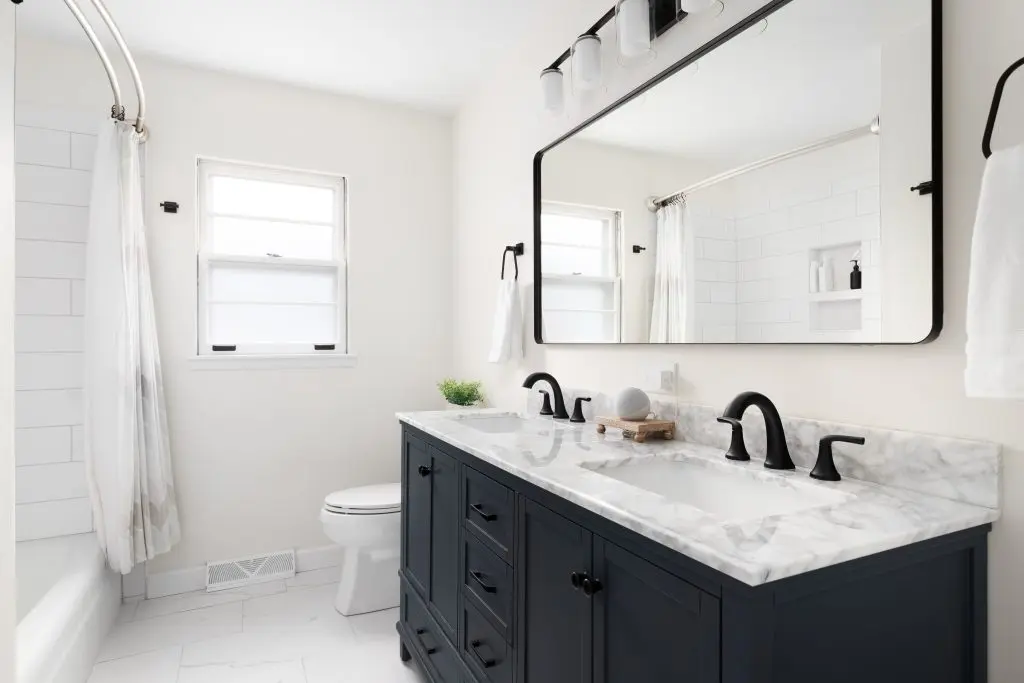
Do I need to replace the bathroom vanity too?
No, you do not necessarily need to replace the vanity when installing a new countertop. A sturdy, level cabinet can often support a replacement stone surface.
The condition of the vanity is more important than its age. If the cabinet has water damage, loose joints, swelling, or structural movement, installing an expensive new countertop over it may create problems later.
We typically look for:
- Water damage around the sink cabinet
- Loose or weakened cabinet connections
- Uneven cabinet tops
- Adequate support for the selected stone
- Enough space for the sink and plumbing
- Damage concealed beneath the existing countertop
A countertop-only update makes sense when the existing vanity remains functional. If the cabinet is deteriorating, replacing both components may be the more practical long-term solution.
What countertop material works best with an existing bathroom sink?
Quartz, granite, and marble can all work with an existing sink if the countertop is fabricated around the correct dimensions and mounting requirements. The best material depends on the homeowner’s priorities for maintenance, appearance, and daily use.
Bathrooms create different challenges from kitchens. Toothpaste, cosmetics, skincare products, hair dye, standing water, and cleaning products all come into contact with the countertop.
For homeowners shopping for bathroom countertops in Lyndon, KY, we recommend considering these everyday conditions before choosing a slab.
| Material | Starting Price | Stain Resistance | Maintenance | Main Advantage |
|---|---|---|---|---|
| Granite | $39/sq. ft. | Good with appropriate sealing | Moderate | Natural patterns and durability |
| Quartz | $55/sq. ft. | High for everyday spills | Low | Easy routine maintenance |
| Marble | $75/sq. ft. | More susceptible to staining | Higher | Distinctive natural veining |
These are starting material prices, not guaranteed complete installed prices.
At Granite Empire of Louisville, we work with granite, quartz, and marble and help homeowners understand how each material will perform in the bathroom they actually use.
Is quartz a practical choice for a bathroom countertop replacement?
Yes, quartz is a practical option because it is nonporous and generally resistant to common bathroom stains.
A homeowner replacing an older vanity top may want a surface that does not require routine sealing. Quartz can be particularly useful in a shared family bathroom where several people leave water, toothpaste, and personal care products around the sink.
However, quartz is not damage-proof. We still recommend avoiding harsh chemicals, abrasive cleaners, and excessive heat from styling tools.
Is granite suitable for a bathroom vanity?
Yes, granite works well for bathroom vanities when the cabinet can support it and the stone receives appropriate care.
Granite provides natural color variation and can make an existing vanity look more customized. Its resistance to everyday wear is useful, although sealing may be recommended depending on the specific stone.
We also consider how the granite pattern will look around the sink opening. With highly patterned stone, the placement of the cutout can influence the finished appearance.
Can marble work with an existing bathroom sink?
Yes, marble can be fabricated for an existing bathroom sink, but homeowners should understand its maintenance requirements before choosing it.
Marble can react to acidic substances, including certain bathroom cleaners. Cosmetics and other products may also create staining risks if spills are left on the surface.
If the homeowner appreciates natural veining and is comfortable with careful cleaning, marble can still be an attractive bathroom material.
How much does it cost to replace a bathroom countertop and keep the sink?
The cost depends on the selected stone, countertop dimensions, sink cutout, fabrication, removal of the existing surface, and installation requirements. Reusing the sink may eliminate the cost of purchasing a new fixture, but it does not remove all the labor associated with disconnecting and reinstalling it.
Our starting material prices are:
| Countertop Material | Starting Price |
|---|---|
| Granite | $39 per square foot |
| Quartz | $55 per square foot |
| Marble | $75 per square foot |
For bathroom countertops in Lyndon, KY, the final quote should reflect the actual vanity measurements and the work required for the existing sink.
At Granite Empire of Louisville, we discuss fabrication and installation requirements alongside material selection. This helps homeowners distinguish the stone price from the complete cost of their project.
What happens during a bathroom countertop replacement?
Replacing a bathroom countertop generally involves removing the existing surface, checking the vanity, taking final measurements, fabricating the new material, and installing it around the selected sink configuration.
When the homeowner wants to preserve the original sink, the process requires additional attention to the fixture’s condition and mounting method.
A typical sequence includes:
- Inspect the existing countertop, sink, and vanity.
- Confirm which components will be reused.
- Arrange appropriate plumbing disconnections.
- Remove the existing countertop and sink as needed.
- Verify final dimensions and sink specifications.
- Fabricate the replacement countertop.
- Install the new surface and appropriate sink supports.
- Reconnect plumbing and check for leaks.
Depending on the sink type and original installation, removal may need to happen before the final countertop template is completed.
How long does bathroom countertop fabrication take?
Our typical fabrication timeline is approximately 7-10 days once measurements are finalized and the project is ready for fabrication. Material availability and project complexity can affect the actual schedule.
Reusing an existing sink does not automatically make fabrication faster. The sink opening must still be accurate, and the mounting requirements need to be confirmed before cutting the stone.
We recommend planning plumbing and installation arrangements around the confirmed project schedule rather than assuming the bathroom will remain fully functional throughout the replacement.
Do I need a plumber when replacing a bathroom countertop?
Yes, plumbing work is commonly required because the sink’s supply lines and drain connections often need to be disconnected and reconnected.
Even if the existing sink is reused, removing the countertop can require temporary plumbing disconnection. A qualified plumbing professional should handle connections when required by the scope of work and applicable rules.
After installation, we recommend checking for leaks rather than assuming that reused connections will automatically remain watertight.
What if the old sink breaks during removal?
If the sink breaks or cannot be safely removed, replacement may be necessary. This is especially important with older undermount sinks that have been attached to the existing countertop for many years.
Before starting a project, homeowners should discuss the possibility of damage during removal and agree on how an unexpected sink replacement would be handled.
We prefer addressing this possibility during planning because the new sink may require different cutout dimensions. A last-minute change can affect fabrication and scheduling.
Should you replace the sink while replacing the countertop?
Not necessarily. If the sink works well, fits the new design, and can be reused safely, keeping it may be the sensible choice.
However, replacing it can make sense when the existing sink has cracks, permanent staining, damaged mounting areas, or dimensions that limit the countertop design.
The decision should also account for the faucet. If the homeowner plans to change from a widespread faucet to a single-hole faucet, for example, the countertop hole configuration needs to reflect that choice before fabrication.
FAQ
Can I install a granite countertop with my existing bathroom sink?
Yes, if the sink is compatible with the new countertop and can be safely removed and reinstalled. The granite must be fabricated with the correct opening and support arrangement.
Can I reuse an undermount sink with a quartz countertop?
Often, yes. The sink must be removable without damage, and the new quartz countertop must accommodate an appropriate cutout and mounting system.
Can I replace only the bathroom vanity top?
Yes. If the vanity cabinet is stable, level, and in good condition, replacing only the top is often possible.
Will my bathroom sink need to be disconnected?
Usually, yes. Plumbing connections commonly need to be disconnected during countertop removal and reconnected after installation.
How much does granite cost for a bathroom countertop?
Our granite material pricing starts at $39 per square foot. The complete project price depends on fabrication, installation, and other requirements.
How long does bathroom countertop fabrication take?
Our typical fabrication timeline is 7-10 days after final measurements and project preparation.
Is it better to replace the sink while replacing the countertop?
Replacement makes sense if the existing sink is damaged, incompatible, or difficult to remove safely. A functional, compatible sink can often be reused.
Bathroom Countertop Fabrication and Installation in Louisville, KY
Granite Empire of Louisville serves homeowners in Louisville, KY and surrounding communities, including Lyndon. We provide countertop material selection, custom fabrication, and professional installation for granite, quartz, marble, and other stone surfaces.
For homeowners considering bathroom countertops in Lyndon, KY, we can help determine whether an existing sink and vanity can be preserved while updating the countertop. Our goal is to help you make practical decisions before fabrication begins so the finished bathroom works as well as it looks.