

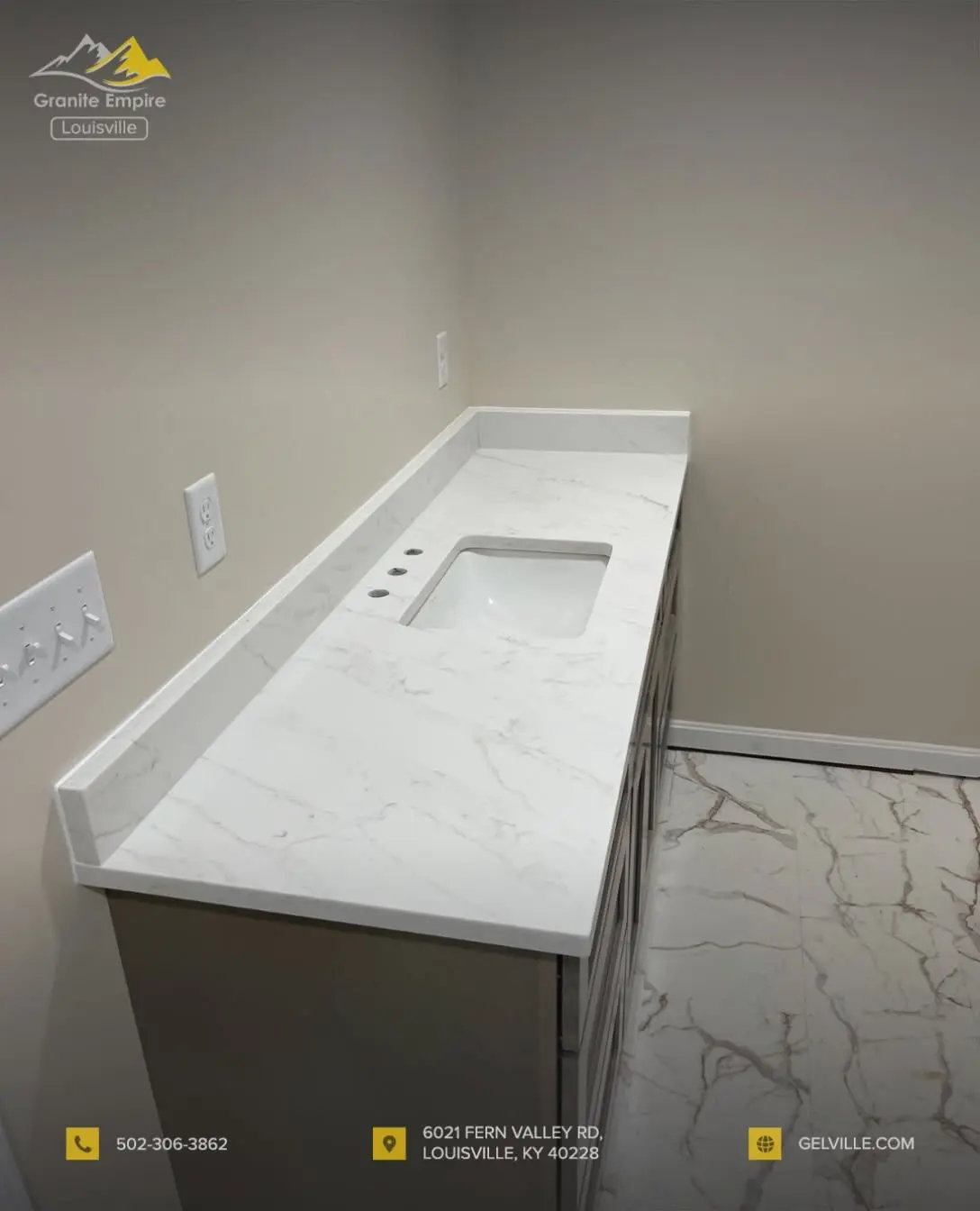
Quartz and granite are both strong choices for a bathroom, but they solve slightly different problems. Quartz is usually better for homeowners who want low maintenance and strong stain resistance, while granite is a better fit for those who prefer natural stone, unique movement, and better heat tolerance.
When customers ask us about bathroom countertops in Louisville, KY, we start with how the room is used. A busy family bathroom, guest bath, and primary suite place different demands on a countertop.
At Granite Empire of Louisville, we fabricate and install granite, quartz, marble, and other stone surfaces, so we help homeowners compare the practical differences before choosing.
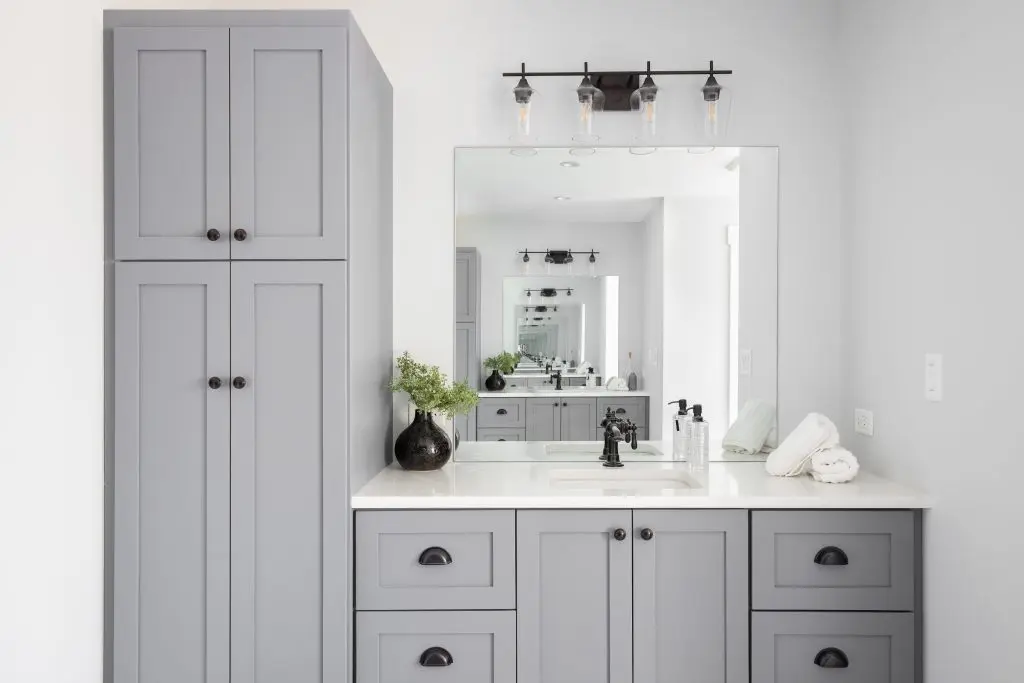
Is quartz or granite better for a bathroom countertop?
For most bathrooms, quartz is the easier material to maintain, while granite offers the character of natural stone and excellent long-term performance when properly sealed.
Quartz is engineered from mineral content combined with resins and pigments. Its surface is nonporous, so it does not require sealing and is highly resistant to common bathroom stains.
Granite is a natural stone. It handles daily use very well, but because it is porous, it typically needs periodic sealing to help resist moisture and staining.
| Feature | Quartz | Granite |
|---|---|---|
| Maintenance | Low; no sealing required | Periodic sealing recommended |
| Stain resistance | Very high | High when properly sealed |
| Heat resistance | Good, but prolonged high heat should be avoided | Very good |
| Pattern | More controlled and consistent | Naturally unique |
| Moisture resistance | Excellent | Excellent when properly sealed |
| Repairability | Small damage can sometimes be repaired | Chips and minor damage can often be repaired |
For homeowners comparing bathroom countertops in Louisville, KY, the decision often comes down to whether they value easier maintenance or the one-of-a-kind look of natural stone.
How do quartz and granite handle water and humidity?
Both materials perform well around sinks and in humid bathrooms when they are installed correctly.
Quartz does not absorb water under normal bathroom use because its surface is nonporous. That makes it especially practical around faucets, sinks, soap dispensers, cosmetics, and other areas that are frequently wet.
Granite also performs well in bathrooms, but the sealer matters. A properly sealed granite vanity top helps prevent water, cosmetics, oils, and colored products from penetrating the stone.
Neither material should be treated as a substitute for good installation. Seams, sink cutouts, faucet holes, backsplashes, and the joint between the countertop and wall all need careful fabrication and installation to reduce places where moisture can collect.
Which material resists bathroom stains better?
Quartz generally has the advantage in stain resistance because it is nonporous.
Bathroom counters are exposed to foundation, hair products, toothpaste, soaps, lotions, and sometimes hair dye. Granite resists these well when sealed and cleaned promptly, while quartz removes the sealing step.
Quartz is not stain-proof, however. Strong dyes and harsh chemicals can still discolor or damage the surface.
What about curling irons, straighteners, and other hot tools?
Granite handles heat better, but we recommend using a heat-resistant mat with both granite and quartz.
Granite is naturally heat resistant, while the resins in quartz can be affected by concentrated heat. We still recommend a heat-resistant mat under curling irons and straighteners on either surface.
Is quartz easier to maintain than granite?
Yes. Quartz normally requires less routine maintenance because it does not need to be sealed.
Mild soap and water are usually enough for both materials. Abrasive cleaners, strong acids, and harsh chemicals may harm the surface or sealer.
If water begins darkening granite instead of beading on the surface, it may be time to check the sealer.
For customers choosing bathroom countertops in Louisville, KY, maintenance is often one of the most important practical differences between these two materials.
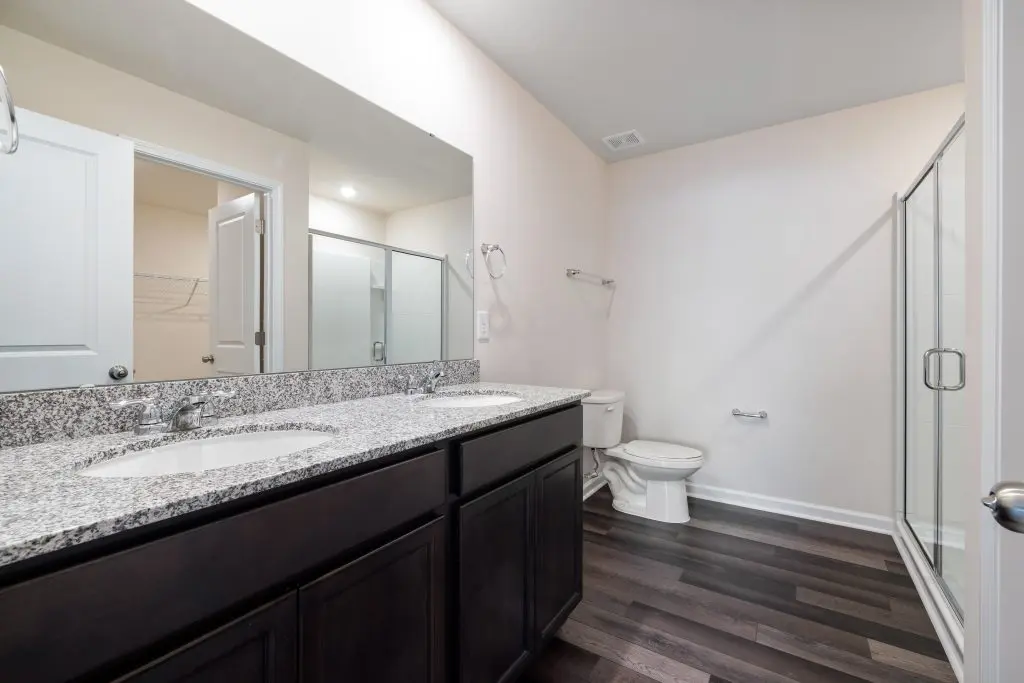
How much do granite and quartz bathroom countertops cost?
Granite is currently the lower starting-price option in our material lineup, followed by quartz and marble.
Our starting material prices are:
| Material | Starting price |
|---|---|
| Granite | $39 per sq. ft. |
| Quartz | $55 per sq. ft. |
| Marble | $75 per sq. ft. |
These starting prices are useful for comparison, but the final total depends on the selected stone, vanity dimensions, sink configuration, edge profile, backsplash, cutouts, and fabrication requirements. A remnant may also work for a smaller vanity when the right size is available.
The main factors that can change the final price include:
- countertop size and shape
- selected granite, quartz, or marble color
- number and type of sink cutouts
- faucet and fixture holes
- edge details
- backsplash requirements
- removal of an existing top
- unusual access or installation conditions
Granite Empire of Louisville can provide an estimate based on actual measurements and the material selected rather than relying on a generic square-foot calculation alone.
Does granite look more natural than quartz?
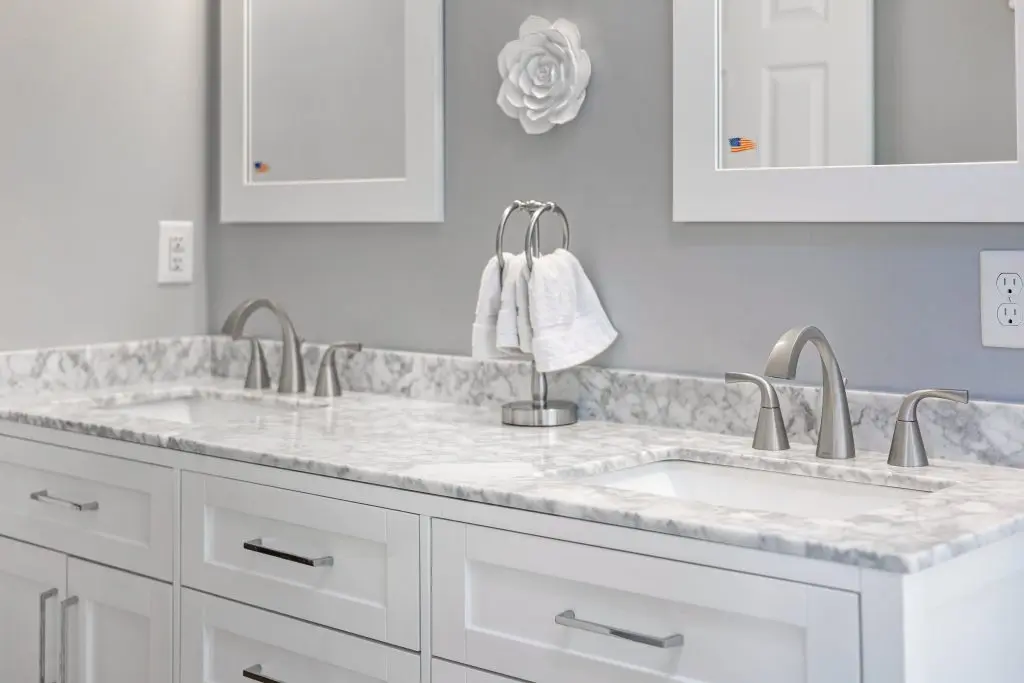
Yes. Granite is a natural stone, so every piece has its own mineral pattern, color variation, and movement.
Quartz offers more control. If a homeowner wants subtle veining or a predictable pattern across a double vanity, quartz may be easier to coordinate with cabinets, tile, flooring, and shower finishes.
The choice is really between natural variation and visual consistency.
Is granite or quartz better for a double vanity?
Quartz is often easier to coordinate across a wide double vanity, but granite can create a stronger natural-stone statement.
Large vanities make pattern direction and seam placement more noticeable. Quartz is generally more predictable, while granite requires more attention to slab layout around sinks, faucets, and seams.
For larger bathroom countertops in Louisville, KY, accurate templating is especially important because walls are not always perfectly straight and vanity cabinets may vary slightly from their nominal dimensions.
Can you install stone on an existing bathroom vanity?
Often, yes, as long as the vanity is structurally sound, level, and suitable for the weight and dimensions of the new stone.
Before templating, the vanity should be installed, level, and stable, with the sink style and faucet configuration selected. Any structural or leveling problems should be corrected before the stone is installed.
What is the installation process for a bathroom countertop?
The process usually includes measurement or templating, fabrication, sink and fixture cutouts, edge finishing, delivery, and final installation.
A typical project with Granite Empire of Louisville can move from template to installation in about 7–10 days, depending on material availability and project details.
The basic process is:
- choose the stone and finalize the vanity layout
- complete templating after the vanity is installed and level
- confirm sink, faucet, edge, and backsplash details
- fabricate the countertop and cut required openings
- deliver and install the finished surface
- complete final fitting and inspect the installation
For bathroom countertops in Louisville, KY, careful measurements matter because even a small vanity may include several precision details in a compact area.
What about marble for bathroom countertops?
Marble is a strong design option for homeowners who accept more maintenance in exchange for natural veining and a classic stone appearance.
It starts at $75 per sq. ft. in our current material pricing. Marble is softer and more sensitive to acids and some personal-care products, so it requires more attention to cleaning and sealing. Etching and patina can also develop over time.
Which countertop should you choose for your bathroom?
Choose quartz if low maintenance, stain resistance, and pattern consistency are your main priorities. Choose granite if you want natural variation, strong heat resistance, and the character of real stone.
A simple way to think about the choice is:
- choose quartz for busy family bathrooms and low-maintenance routines
- choose granite when natural pattern and individuality matter more
- consider marble when the appearance is the priority and extra maintenance is acceptable
At Granite Empire of Louisville, we also encourage customers to compare samples in person because photos do not always show true undertones, crystal structure, veining, or how a surface works with bathroom lighting.
FAQ
Is quartz waterproof enough for a bathroom?
Quartz is nonporous and highly resistant to water under normal bathroom use. Proper installation around sinks, faucets, seams, and walls is still important.
Does granite need to be sealed in a bathroom?
Usually, yes. Granite is porous, and periodic sealing helps reduce moisture and stain absorption.
Can a hot curling iron damage quartz?
It can. Concentrated heat may affect the resin in quartz, so a heat-resistant mat is recommended.
Is granite cheaper than quartz?
Based on our current starting material prices, granite starts at $39 per sq. ft. and quartz starts at $55 per sq. ft. Final project cost depends on the selected material and fabrication details.
How long does bathroom countertop installation take?
Our typical timeline from template to installation is about 7–10 days, depending on material availability and project complexity.
Can you replace the countertop without replacing the vanity?
Often, yes. The existing vanity must be level, stable, structurally sound, and suitable for the new stone top.
Is marble better than quartz for a bathroom?
Not for every homeowner. Marble offers natural veining but requires more maintenance, while quartz is easier to care for and more resistant to everyday staining.
Bathroom Countertop Fabrication and Installation in Louisville, KY
Granite Empire of Louisville serves homeowners in Louisville, KY and surrounding communities with countertop templating, fabrication, delivery, and installation. We work with granite, quartz, marble, and other stone options for bathroom vanities, kitchens, and custom surfaces.
If you are comparing bathroom countertops in Louisville, KY, we can help you review material options, starting prices, maintenance needs, and the details that affect your final installation.