

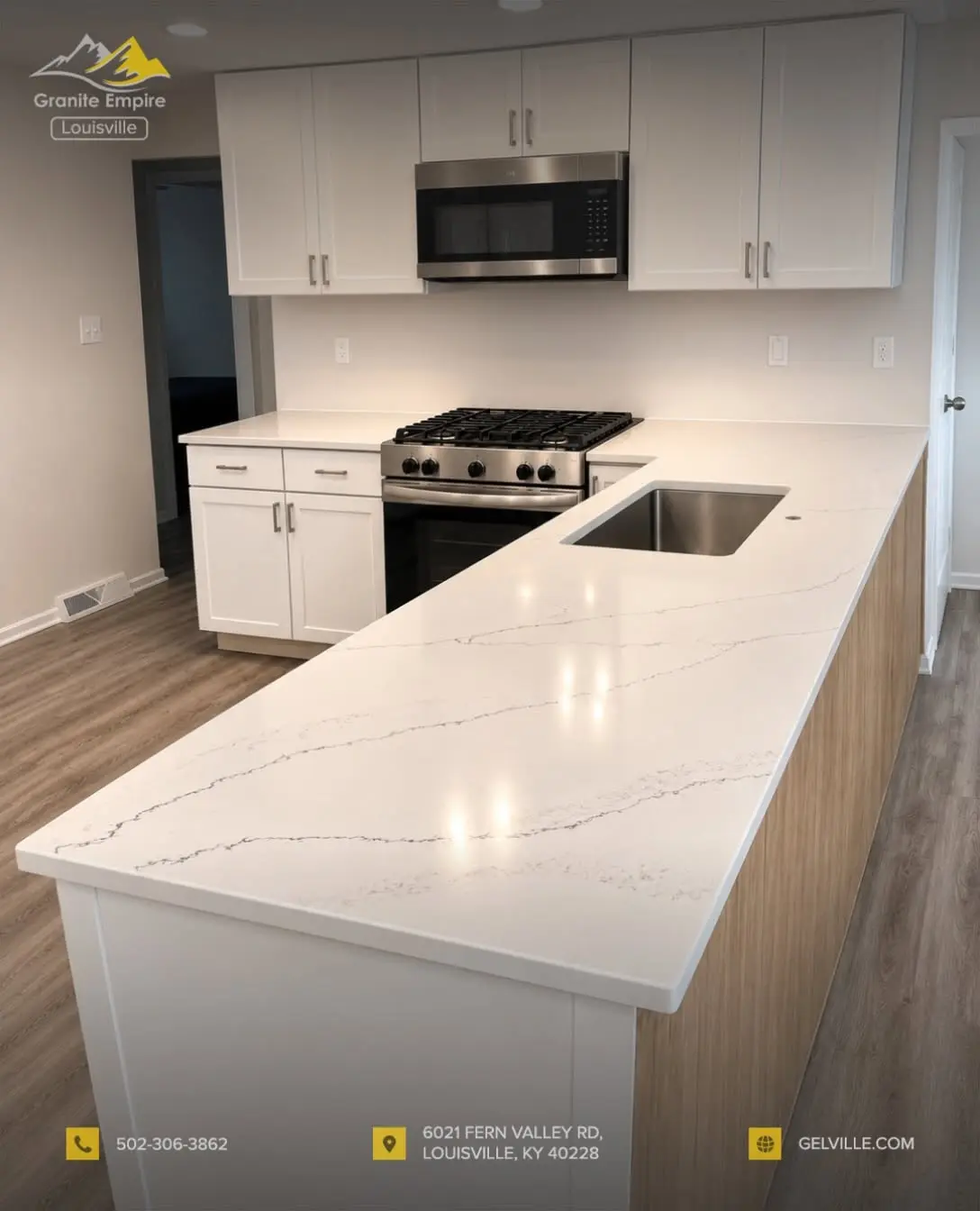
Visible seams in quartz countertops are usually the result of joining two or more stone sections during fabrication and installation. Although professional fabricators work to make these joints as subtle as possible, seams cannot always be eliminated completely. Their visibility depends on the quartz pattern, slab color, lighting, installation precision, and the technique used to join the pieces.
When homeowners research quartz countertops in Louisville, KY, they often expect a continuous surface without visible lines. However, even premium quartz slabs have dimensional limitations, and larger kitchens, islands, and L-shaped layouts frequently require multiple pieces. At Granite Empire of Louisville, we pay particular attention to seam placement, color matching, and alignment to achieve a clean, consistent appearance.
Understanding why seams appear can help homeowners distinguish between a normal fabrication joint and an installation problem that needs attention.

Are Visible Seams Normal in Quartz Countertops?
Yes, visible seams are normal in quartz countertop installations that require multiple slabs or sections. Quartz manufacturers produce slabs in specific dimensions, so a countertop that exceeds the available slab size must be fabricated from separate pieces.
This is particularly common in kitchens with large islands, long countertop runs, U-shaped layouts, and extended breakfast bars. Even when two pieces come from the same quartz slab, the joint may remain slightly noticeable.
The goal of professional fabrication is not necessarily to make the seam disappear completely. Instead, we aim to create a tight, stable connection that blends naturally with the surrounding surface.
A properly executed seam should generally have:
- A narrow and consistent joint.
- Closely aligned countertop edges.
- Color-matched adhesive.
- Minimal height difference between sections.
- No loose material or visible gaps.
A seam that feels significantly raised, has uneven edges, or begins separating deserves further inspection.
What Makes Quartz Countertop Seams More Noticeable?
Seams become more noticeable when the two adjoining pieces differ in color, pattern, height, or surface reflection. Several factors influence the final appearance.
1. Quartz Color and Pattern
The design of the material plays a major role in seam visibility. Solid-color quartz is often easier to join discreetly because the pattern does not need to continue across the connection.
Quartz with prominent veins, dramatic movement, or contrasting patterns presents a greater challenge. If the veining does not align naturally, the joint can become more noticeable even when the fabrication itself is precise.
For example, Calacatta-style quartz often features large gray or gold veins against a white background. When two sections meet, the direction and placement of those veins can make the seam stand out.
2. Lighting Conditions
Lighting can make a seam appear more prominent than it does under ordinary conditions. Natural light from windows, under-cabinet lighting, and overhead fixtures can highlight small differences in surface reflection.
This is especially noticeable on polished white quartz. A joint that looks subtle in a showroom may appear more visible when installed beneath strong directional lighting.
3. Edge Alignment
Uneven edges can create a visible line or a slight height difference between countertop sections. This may happen when pieces are not properly prepared, positioned, or secured during installation.
Even a small difference can become noticeable when light reflects across the polished surface.
4. Adhesive Color
Fabricators use specialized adhesives to connect quartz sections. The adhesive is selected to complement the countertop color and, when possible, its pattern.
If the adhesive color is too light, too dark, or noticeably different from the surrounding material, the seam may stand out.
At Granite Empire of Louisville, we consider these details during material selection and fabrication rather than treating the seam as an afterthought.
Does the Type of Quartz Affect Seam Visibility?
Yes, some quartz designs are easier to seam discreetly than others. Pattern complexity, background color, and vein direction all influence how naturally two sections appear to connect.
Here is how common quartz styles compare:
| Quartz Style | Seam Visibility | Main Consideration |
|---|---|---|
| Solid white quartz | Usually lower | Consistent background makes color matching easier |
| Solid gray quartz | Usually lower | Uniform color helps conceal small joints |
| Fine-speckled quartz | Moderate | Small patterns can help disguise the connection |
| Marble-look quartz | Moderate to high | Veining alignment matters |
| Dramatic-vein quartz | Potentially high | Large patterns can make mismatched sections obvious |
| Dark polished quartz | Moderate | Lighting and adhesive contrast can highlight joints |
This does not mean homeowners should avoid patterned quartz. Instead, we recommend reviewing the actual slabs and discussing seam locations before fabrication begins.
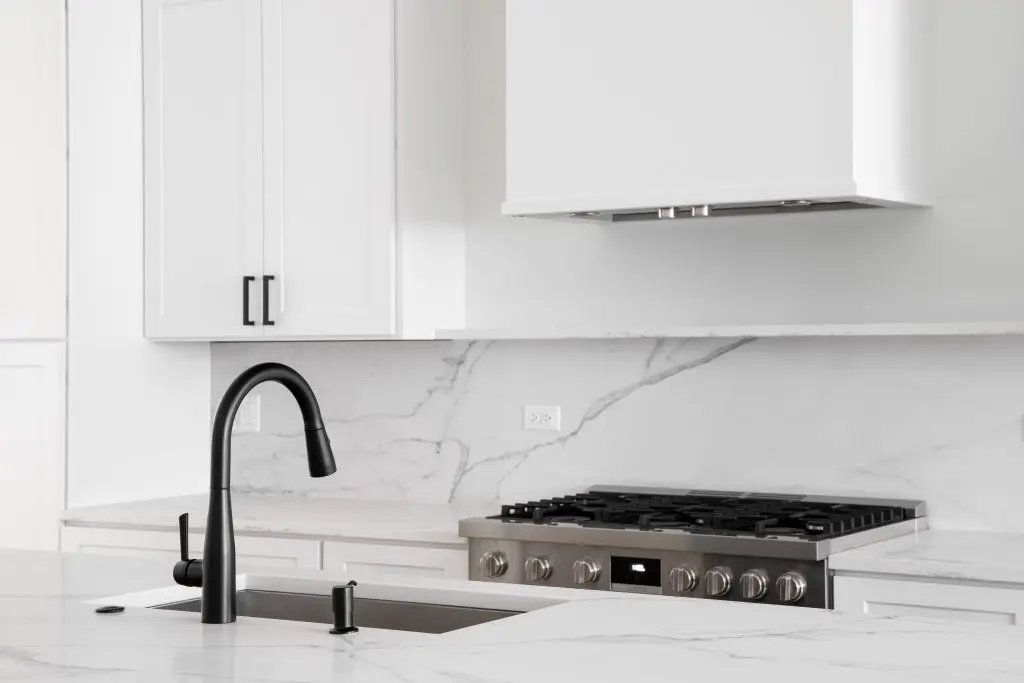
Can Quartz Countertop Seams Be Made Less Visible?
Yes, professional fabrication techniques can significantly reduce seam visibility, although they cannot guarantee a completely invisible connection.
The process begins before installation. We evaluate the slab pattern, determine where separate sections will meet, and select an appropriate adhesive color.
Several techniques help improve the final result:
- Careful seam placement: We position joints in less visually prominent locations whenever the layout allows.
- Color-matched adhesive: We select an adhesive that complements the quartz background and pattern.
- Precise edge preparation: We prepare adjoining edges to achieve a close, consistent fit.
- Accurate alignment: We position sections at the same height and check the connection before the adhesive cures.
- Pattern coordination: We consider the direction and movement of visible veins when planning the layout.
For quartz countertops in Louisville, KY, these details are particularly important in kitchens with large islands or dramatic marble-look surfaces.
Where Should Seams Be Placed in a Quartz Countertop?
Seams should be placed in locations that provide structural stability while minimizing their visual impact. The best location depends on the kitchen layout, slab dimensions, cabinet configuration, and material pattern.
We generally evaluate several possible locations during the fabrication planning stage.
Common seam placement considerations include:
- Kitchen islands: The dimensions of the island may require a joint, depending on available slab sizes.
- L-shaped countertops: A joint may be necessary near a corner or transition.
- Long countertop runs: Separate sections may be needed when the total length exceeds the slab dimensions.
- Sink areas: We consider the cutout, cabinet support, and surrounding countertop geometry when planning joints.
- Cooktop areas: We evaluate the available material and cutout placement before determining the most practical layout.
A seam should not be placed solely for visual convenience if doing so compromises support or creates an unnecessarily weak connection.
Can Poor Installation Cause Uneven or Opening Seams?
Yes, improper installation can contribute to uneven seams, gaps, and joint separation. Although some visibility is expected, physical problems at the connection may indicate an issue beyond ordinary fabrication.
One possible cause is inadequate cabinet support. Quartz is a heavy material, and the cabinets beneath it must provide a stable, properly leveled foundation.
Other contributing factors include:
- Uneven or improperly prepared cabinet surfaces.
- Inaccurate measurements.
- Poorly prepared adjoining edges.
- Inadequate adhesive application.
- Movement in the supporting cabinetry.
- Insufficient support around certain countertop sections.
We also consider the possibility of movement caused by changes in the surrounding structure or cabinets.
If a seam begins opening after installation, simply applying more adhesive over the joint may not address the underlying cause. We first need to determine why the connection has moved.
Can an Existing Quartz Countertop Seam Be Repaired?
In many cases, a damaged or poorly finished seam can be improved without replacing the entire countertop. However, the appropriate repair depends on whether the problem involves appearance, adhesive failure, or movement between sections.
For example, a seam with discolored adhesive may need professional joint refinishing. A connection with uneven edges may require more involved corrective work.
We distinguish between several situations:
| Seam Problem | Possible Solution |
|---|---|
| Discolored adhesive | Professional seam refinishing |
| Small cosmetic imperfections | Localized seam correction |
| Slight height difference | Professional evaluation and possible corrective work |
| Opening joint | Inspection, preparation, and appropriate reseaming |
| Cracked quartz near the seam | Assessment of structural cause and repair options |
Not every seam can be corrected to look like a new installation. If the underlying material is cracked or the supporting cabinets are unstable, those issues must be addressed first.
How Does Quartz Compare With Granite and Marble When It Comes to Seams?
Quartz, granite, and marble all require careful seam planning when a countertop layout involves multiple sections. However, their natural patterns, material characteristics, and maintenance requirements differ.
| Feature | Quartz | Granite | Marble |
|---|---|---|---|
| Material | Engineered stone | Natural stone | Natural stone |
| Pattern consistency | Generally more predictable | Naturally variable | Naturally variable |
| Seam matching | Depends on design and veining | Depends on individual slab patterns | Depends on veining and slab selection |
| Heat resistance | More sensitive to high temperatures | Generally high | Generally moderate to high |
| Stain resistance | Generally high | Depends on sealing and stone characteristics | More susceptible to staining |
| Routine sealing | Not normally required | Usually recommended | Usually recommended |
| Maintenance | Relatively simple | Periodic sealing and routine cleaning | More careful cleaning and protection |
Natural stone can have more variation between individual slabs, which sometimes makes matching two adjoining sections challenging. Engineered quartz offers more predictable manufacturing patterns, but dramatic vein designs still require careful planning.
What Are the Starting Prices for These Countertop Materials?
Material selection also affects the overall countertop budget. The following are the starting prices provided for our Louisville market:
| Material | Starting Price |
|---|---|
| Granite | $39 |
| Quartz | $55 |
| Marble | $75 |
These are starting material prices, not guaranteed final installed project totals. The final estimate depends on countertop dimensions, slab selection, edge profiles, cutouts, fabrication requirements, and installation details.
When comparing quartz countertops in Louisville, KY, we recommend looking at the complete project estimate rather than comparing material prices alone.
How Long Does Quartz Countertop Fabrication and Installation Take?
A typical fabrication timeline is approximately 7-10 days, although the actual schedule depends on material availability, project complexity, and installation scheduling.
The process generally includes:
- Measurement and templating: We measure the cabinets and confirm the countertop layout.
- Slab selection: We review the material, pattern, and potential seam locations.
- Fabrication: We cut the quartz, prepare edges, and create necessary openings.
- Seam preparation: We prepare adjoining sections and coordinate the adhesive color.
- Installation: We position, level, and secure the countertop sections.
- Final inspection: We check the joints, edges, cutouts, and overall fit.
At Granite Empire of Louisville, we pay attention to seam placement during the planning process because correcting a poor layout after fabrication can be significantly more complicated.
How Can Homeowners Avoid Noticeable Seams When Choosing Quartz?
The best way to reduce seam visibility is to discuss the countertop layout before purchasing the material. Waiting until installation day to consider seam placement leaves fewer opportunities to adjust the design.
We recommend asking the fabricator these questions:
- Will my countertop require one or multiple slabs?
- Where will the seams be located?
- Can we review the actual slab before fabrication?
- Does the pattern require special vein alignment?
- What adhesive color will be used?
- Are there any areas where cabinet support needs to be improved?
For quartz countertops in Louisville, KY, reviewing these details before fabrication can help prevent misunderstandings and create more realistic expectations about the finished appearance.

FAQ
Are quartz countertop seams supposed to be visible?
Yes. Seams may remain slightly visible even after professional installation. Their appearance depends on the material, adhesive, pattern, and fabrication precision.
Can you have a quartz countertop without seams?
Sometimes, depending on the countertop dimensions and available slab sizes. Larger layouts often require multiple sections.
Are seams more noticeable on white quartz?
They can be. White surfaces may make differences in adhesive color and surface reflection easier to notice.
Can quartz seams turn yellow over time?
Certain adhesives can discolor with age or exposure to environmental conditions. The cause should be evaluated before attempting repairs.
Does a visible seam mean the countertop was installed incorrectly?
No. Visible seams are normal when multiple sections are joined. However, gaps, separation, and significant height differences may indicate installation problems.
Can a quartz countertop seam be moved?
Moving a seam usually requires substantial refabrication and may not be practical with an existing installation. The available options depend on the countertop layout and material condition.
Are quartz countertop seams waterproof?
A properly prepared and bonded seam is designed to create a durable connection, but it should not be treated as a guarantee of complete waterproofing under every condition.
Quartz Countertop Fabrication and Installation in Louisville, KY
At Granite Empire of Louisville, we help homeowners in Louisville and surrounding communities select, fabricate, and install granite, quartz, and marble countertops. We pay attention to slab selection, precise measurements, seam placement, edge details, and proper installation to achieve a result that looks cohesive and performs well in everyday use.
If you are planning a new kitchen or replacing existing surfaces, we can help you understand your material options and discuss the best countertop layout for your space. Our goal is to make sure the finished installation looks as intentional as the original design.