

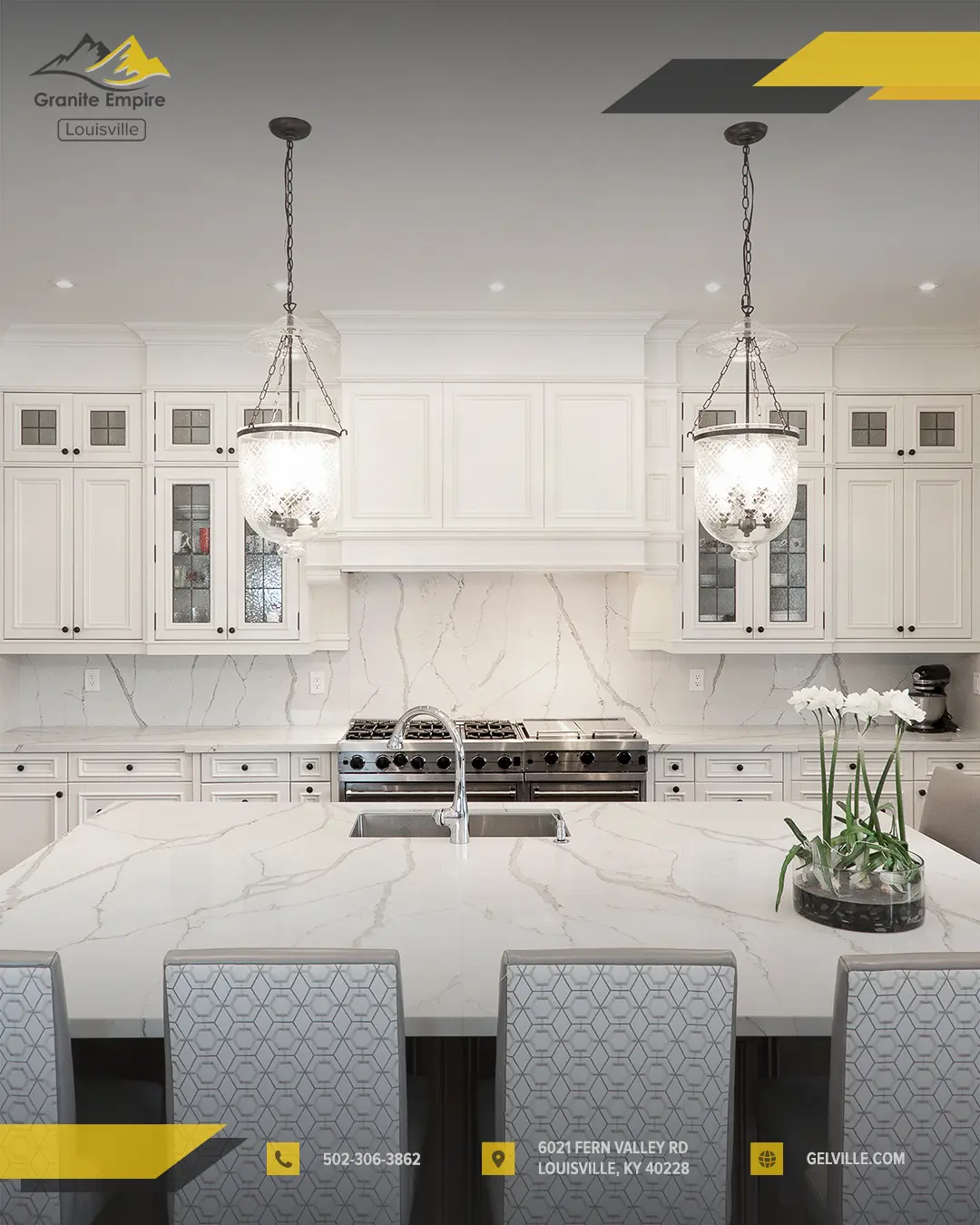
Quartz countertops can discolor from heat because engineered quartz contains polymer resins that are more heat-sensitive than the mineral component itself. When a very hot pan, baking sheet, electric appliance, or other heat source transfers enough energy into the surface, the resin can change color, lose clarity, or develop a yellow, brown, or cloudy-looking area.
This is why we tell homeowners comparing countertop installers in Fort Knox, KY that quartz is durable, but it should not be treated like a heat-proof surface. At Granite Empire of Louisville, we recommend using trivets or heat-resistant pads even for short contact with very hot cookware.
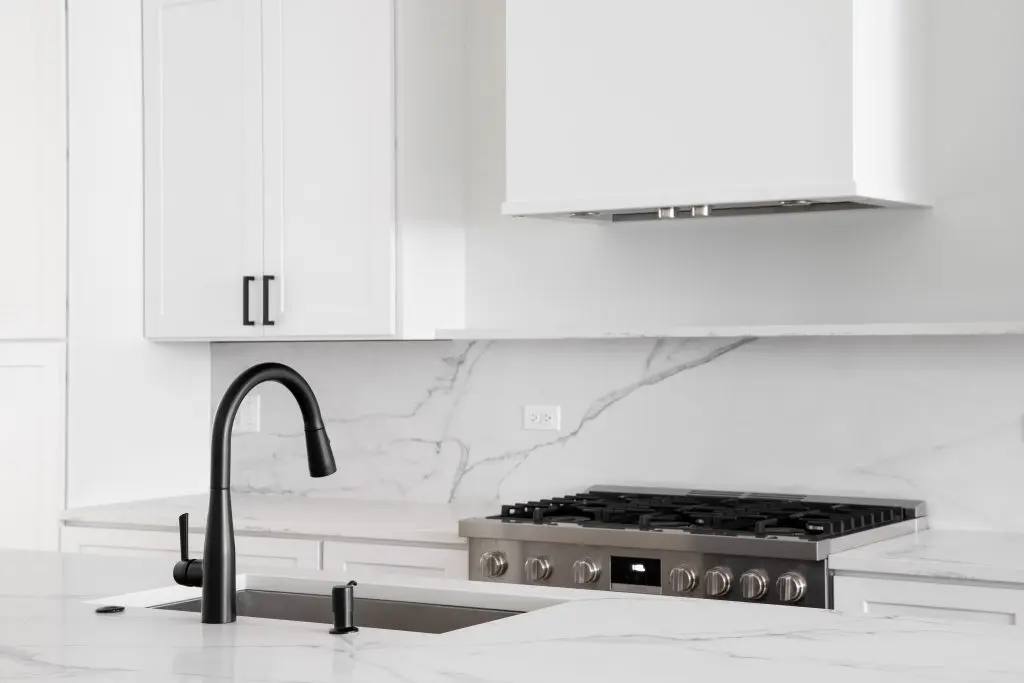
Why Does Heat Affect Quartz Differently Than Granite?
The main reason is composition. Quartz countertops are engineered surfaces made with quartz mineral particles combined with binders, pigments, and polymer resins, while granite is a natural stone.
Quartz mineral itself tolerates high temperatures, but the resin system can react to concentrated heat before the mineral does. That means the countertop can show discoloration or finish changes even when there is no obvious crack.
Granite has a different structure and generally provides better resistance to direct kitchen heat. We still recommend using trivets on any countertop because rapid temperature changes and concentrated heat can create unnecessary risk.
What Does Heat Damage on Quartz Look Like?
Heat damage can appear as yellowing, browning, whitening, cloudiness, or a dull patch that does not disappear after normal cleaning. The exact appearance depends on the quartz product, color, resin formulation, temperature, contact time, and type of heat source.
A homeowner may first assume the mark is grease or a stain. If cleaning does not change it and the area appeared immediately after contact with a hot item, the finish or resin may have been altered rather than simply soiled.
Common situations include:
- A hot skillet placed directly on the countertop
- A baking sheet moved straight from the oven to the quartz
- A countertop appliance that produces sustained heat underneath
- A hot pot left in one place for an extended period
- Repeated exposure to the same concentrated heat source
For homeowners working with countertop installers in Fort Knox, KY, understanding this difference before installation helps prevent damage after the kitchen is complete.
Can One Hot Pan Permanently Discolor Quartz?
Yes, it can. A single exposure may be enough if the temperature is high, contact is direct, and the heat remains concentrated in one area long enough to affect the resin.
There is no one temperature limit that applies to every quartz brand. Manufacturers use different formulations and publish their own care requirements, so we recommend following the warranty and heat guidance for the exact product installed in the home.
This is also why generic online claims about a single “safe temperature” can be misleading. The safer everyday habit is simple: keep very hot cookware off direct contact with quartz.
Is Quartz Heat Damage the Same as a Stain?
No. A stain is typically a substance that has discolored or penetrated a surface, while heat damage can physically or chemically alter the resin or finish.
Cleaning products may remove cooking residue sitting on top of the countertop, but they cannot reverse resin that has changed color from excessive heat. Aggressive scrubbing can make the area worse by changing the surrounding finish.
At Granite Empire of Louisville, we recommend identifying the cause before trying stronger chemicals or abrasive products on a suspicious mark.
Can Heat Cause Quartz to Crack Too?
Yes, severe or sudden temperature changes can contribute to cracking as well as discoloration. Engineered quartz expands and contracts with temperature, and concentrated thermal stress can be especially problematic near edges, seams, sink cutouts, and cooktop openings.
Heat is not the only reason quartz cracks. Cabinet movement, insufficient support, impact, fabrication stress, or installation conditions can also contribute.
If a crack appears, we look at its location and the surrounding installation rather than assuming heat was automatically the cause.
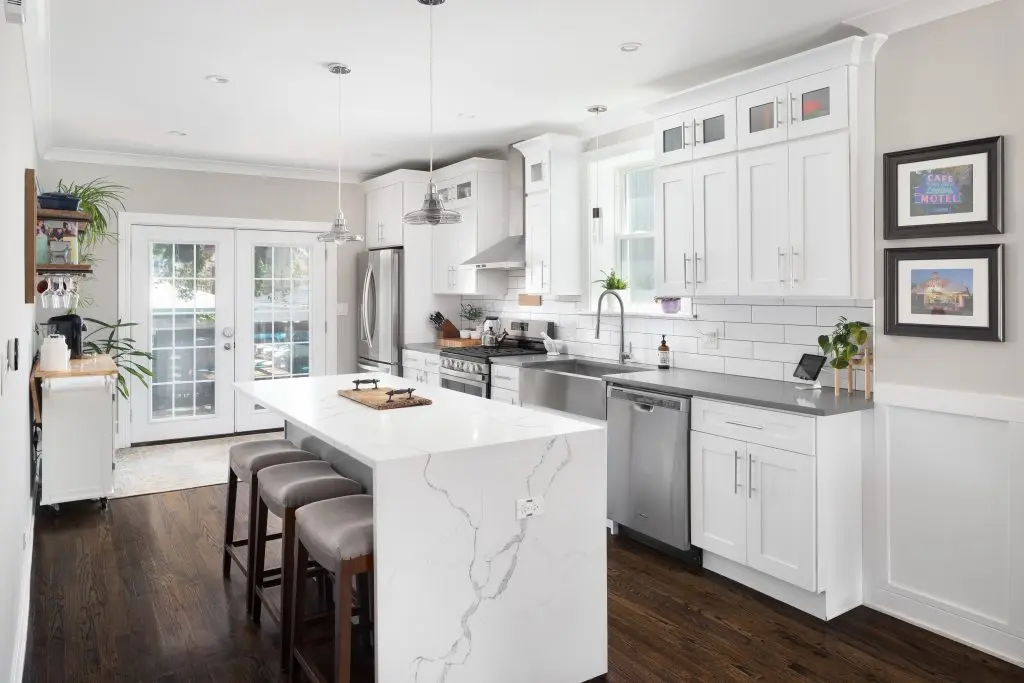
Are Areas Around Cooktops More Vulnerable?
They can be. Cooktop cutouts create narrower sections of material, and nearby countertop areas may experience repeated heat exposure during normal cooking.
Proper appliance clearances and manufacturer installation requirements matter. The countertop fabricator also needs accurate appliance specifications before cutting the opening.
For countertop installers in Fort Knox, KY, coordination between templating, fabrication, appliance dimensions, and final installation is important because the cooktop area is both structurally and thermally demanding.
Can Small Appliances Discolor Quartz?
Yes, appliances that release heat downward or remain hot for long periods can affect the surface underneath them. Slow cookers, toaster ovens, countertop grills, air fryers, and similar appliances vary widely in how they vent and transfer heat.
We recommend checking both the appliance instructions and the quartz manufacturer’s care requirements. If an appliance creates significant heat underneath, a suitable heat barrier may be needed.
The risk is different from briefly setting down a warm coffee mug. Duration and concentration of heat both matter.
How Do Quartz, Granite, and Marble Compare With Heat?
Granite and marble are natural stones and generally tolerate kitchen heat better than resin-bound engineered quartz. However, none of these surfaces benefits from repeated thermal shock.
| Material | Heat Resistance | Main Heat Concern | Routine Recommendation |
|---|---|---|---|
| Granite | High | Thermal shock and localized stress | Use trivets for very hot cookware |
| Quartz | Moderate | Resin discoloration, finish changes, thermal stress | Do not place very hot cookware directly on surface |
| Marble | High | Thermal shock; surface is still vulnerable to etching from acids | Use trivets and protect from acidic spills |
Heat resistance should not be confused with overall durability. Marble can handle heat well but is much more sensitive to acidic ingredients, while quartz resists many stains but needs more protection from direct high heat.
Does Quartz Color Affect How Heat Damage Looks?
Yes. The same type of damage can be more noticeable on some colors and patterns than others. Light quartz may show yellow or brown discoloration clearly, while dark quartz can show cloudy or dull areas that contrast with the surrounding finish.
Pattern can also hide or emphasize a damaged spot. A busy design may make a small change less obvious, but the material has still been affected.
Color should therefore be chosen for design, not as a strategy for making heat damage acceptable.
Can Heat-Damaged Quartz Be Repaired?
Sometimes a localized cosmetic issue can be improved, but true resin discoloration is not always reversible. The repair options depend on the depth, size, location, color, and exact nature of the damage.
Quartz does not respond to restoration in the same way as marble or some natural stones. A marble surface can often be honed and repolished after etching, while engineered quartz contains a manufactured resin system that cannot simply be recreated on-site through stone polishing.
Severe heat damage may require a localized professional repair or, in some cases, replacement of the affected section. We do not recommend assuming a polishing compound will fix it.
How Can You Prevent Heat Discoloration?
The most reliable approach is to prevent direct high-heat contact. This does not require complicated maintenance.
We recommend:
- Use trivets under hot pots and pans
- Place baking sheets on heat-resistant pads
- Do not move cookware directly from the oven or stove onto quartz
- Check heat-producing countertop appliances
- Follow the exact quartz manufacturer’s care instructions
- Keep appliance installation clearances consistent with manufacturer requirements
These habits matter whether the countertop is new or has been in the kitchen for years.
Is Quartz Still a Good Choice for a Busy Kitchen?
Yes. Quartz remains a practical option for homeowners who value consistent appearance, good stain resistance, and relatively simple routine maintenance. Its heat sensitivity is a limitation to manage, not a reason that the material is unsuitable for every kitchen.
A household that routinely places very hot cookware directly on the counter may prefer granite. A homeowner who uses trivets consistently may find quartz easy to live with.
When homeowners compare countertop installers in Fort Knox, KY, we recommend discussing cooking habits alongside color and pattern instead of selecting a material based on appearance alone.
How Much Do Quartz, Granite, and Marble Countertops Cost?
Our current starting material prices are $39 per square foot for granite, $55 per square foot for quartz, and $75 per square foot for marble. These are starting material prices, not universal installed totals.
| Material | Starting Material Price | Heat Performance | Maintenance Consideration |
|---|---|---|---|
| Granite | $39/sq. ft. | High | May require sealing depending on the stone |
| Quartz | $55/sq. ft. | Moderate | No routine sealing, but protect from high heat |
| Marble | $75/sq. ft. | High | More sensitive to etching and staining |
Final project pricing can also depend on square footage, edge details, sink and cooktop cutouts, seams, delivery, fabrication, and installation.
How Long Does Countertop Fabrication Take?
Our typical fabrication timeline is about 7-10 days after templating when the selected material is available and the project is ready for production. Complex layouts, unusual fabrication details, or material availability can affect scheduling.
A typical project includes:
- Selecting the material.
- Confirming cabinet readiness.
- Measuring or templating the countertop.
- Planning seams and cutouts.
- Fabricating the pieces.
- Delivering and installing the finished countertop.
At Granite Empire of Louisville, we provide fabrication and installation for granite, quartz, marble, and other countertop materials.
Why Does Fabrication Matter Around Heat Sources?
Fabrication matters because areas around cooktops and other openings contain less material than an uninterrupted countertop section. Accurate cutouts, appropriate corner treatment, correct support, and proper appliance clearances all contribute to the finished installation.
Heat protection cannot compensate for a poor installation, and good fabrication cannot make quartz immune to excessive heat. Both the countertop design and everyday use matter.
This is one reason experienced countertop installers in Fort Knox, KY should review appliance specifications before fabrication whenever the countertop includes a cooktop cutout.
What Maintenance Does Quartz Need?
Quartz generally needs simple routine cleaning rather than sealing. A soft cloth, mild cleaner approved for the surface, and prompt cleanup are usually enough for everyday care.
Avoid abrasive pads and harsh chemicals unless the manufacturer specifically approves them. They can change the finish even when the countertop has not been damaged by heat.
Granite maintenance can differ because some stones benefit from periodic sealing. Marble requires additional caution around acidic foods and cleaners because sealing does not prevent etching.
FAQ
Can quartz countertops turn yellow from heat?
Yes. Excessive concentrated heat can alter the resin and produce yellow, brown, cloudy, or dull-looking discoloration.
Can you put a hot pan directly on quartz?
We do not recommend it. Use a trivet or heat-resistant pad to prevent resin damage and thermal stress.
Is heat discoloration on quartz permanent?
It can be. Some true resin damage cannot be removed through ordinary cleaning or polishing.
Is granite more heat-resistant than quartz?
Generally, yes. Granite is natural stone without the polymer resin system used in engineered quartz, although we still recommend using trivets.
Does quartz need sealing?
Generally, engineered quartz does not require routine sealing because it is manufactured as a nonporous surface.
Can an air fryer damage quartz?
Potentially. Some appliances release enough sustained heat underneath to affect quartz, so follow both the appliance and countertop manufacturer’s instructions.
How long does countertop fabrication take?
Our typical fabrication period is about 7-10 days after templating, depending on material availability and project complexity.
Quartz Countertops and Installation Near Fort Knox, KY
Granite Empire of Louisville serves Louisville, KY and surrounding communities, including Fort Knox, KY, with countertop fabrication and installation. We work with quartz, granite, marble, and other surfaces and help homeowners compare heat performance, maintenance, appearance, fabrication requirements, and everyday kitchen use before choosing a material.
If you are comparing countertop installers in Fort Knox, KY, we can help you understand where quartz works well, where heat protection matters, and how appliance cutouts and fabrication should be planned. Granite Empire of Louisville can also coordinate the countertop from templating through fabrication and final installation.